
 Bitcoin
  Ethereum
  Tether
  BNB
BNB  USDC
USDC  XRP
XRP  Solana
  TRON
TRON  Lido Staked Ether
  Figure Heloc
  Hyperliquid
  Dogecoin
  USDS
USDS  Rain
Rain  LEO Token
  Wrapped stETH
  Zcash
Zcash  WhiteBIT Coin
  Wrapped Bitcoin
  Cardano
  Binance Bridged USDT (BNB Smart Chain)
  Stellar
  Wrapped Beacon ETH
  Monero
  Chainlink
  Canton
  Wrapped eETH
  Bitcoin Cash
  Dai
Dai  sUSDS
sUSDS  USD1
USD1  Ethena USDe
  Gram (prev. Toncoin)
  Coinbase Wrapped BTC
  Litecoin
  Global Dollar
  Circle USYC
  WETH
WETH  Hedera
  Sui
Sui  PayPal USD
  USDT0
USDT0  Avalanche
  Cronos
  Tether Gold
  Shiba Inu
  NEAR Protocol
  BlackRock USD Institutional Digital Liquidity Fund
  Ondo US Dollar Yield
  Ethena Staked USDe
  Uniswap
  Bittensor
  World Liberty Financial
  PAX Gold
  MemeCore
  Aster
Aster  HTX DAO
  OKB
OKB  Ripple USD
  Ondo
Ondo  Little Pepe
  USDD
USDD  syrupUSDC
  Falcon USD
  Polkadot
  Morpho
  Mantle
  DeXe
DeXe  Aave
Aave  BFUSD
BFUSD  Worldcoin
  Sky
Sky  Internet Computer
  Bitget Token
  Pi Network
  Ethereum Classic
  Pepe
Pepe  United Stables
  Jupiter Perpetuals Liquidity Provider Token
  Spiko EU T-Bills Money Market Fund
  Blockchain Capital
  Quant
Quant  KuCoin
  Janus Henderson Anemoy Treasury Fund
  Jito Staked SOL
  USDGO
USDGO  Stable
  Kelp DAO Restaked ETH
  Invesco Short Duration US Government Securities Fund
  JUST
JUST  Binance-Peg WETH
  POL (ex-MATIC)
  Rocket Pool ETH
  Cosmos Hub
  Kaspa
Kaspa  Binance Bridged USDC (BNB Smart Chain)
  Render
  Algorand
  Wrapped BNB
  ADI
ADI  Function FBTC
  Beldex
  USDtb
USDtb  NEXO
NEXO  Jupiter
  LAB
LAB  syrupUSDT
  Spiko Amundi Overnight Swap Fund (EUR)
  币安人生 (BinanceLife)
  Gate
Gate  Binance Staked SOL
  Ethena
  Audiera
  Janus Henderson Anemoy AAA CLO Fund
  Filecoin
  GHO
GHO  Pump.fun
  NEW X CEO IS BACK
  Polygon Bridged USDC (Polygon PoS)
  Lighter
  Solv Protocol BTC
  Flare
Flare  Lombard Staked BTC
  Usual USD
  XDC Network
  YLDS
YLDS  clBTC
clBTC  Midnight
  Provenance Blockchain
  USX
USX  Aptos
Aptos  Aerodrome Finance
  Venice Token
  StakeWise Staked ETH
  TrueUSD
  Arbitrum
  Kinetiq Staked HYPE
  A7A5
A7A5  tBTC
tBTC  Injective
  PancakeSwap
  Dash
Dash  EURC
EURC  VeChain
  Ondo Short-Term U.S. Government Bond Fund
  Pudgy Penguins
  c8ntinuum
  Hastra PRIME
  Mantle Staked Ether
  Official Trump
  Celestia
  Polygon PoS Bridged DAI (Polygon POS)
  Ether.fi
  Resolv wstUSR
  Artificial Superintelligence Alliance
  COCA
COCA  Sun Token
  Bonk
Bonk  SPX6900
  Doge Strategy
  Liquid Staked ETH
  First Digital USD
  Arbitrum Bridged WBTC (Arbitrum One)
  LayerZero
  Virtuals Protocol
  Pyth Network
  The9bit
  Terra Luna Classic
  Wrapped Flare
  Kinesis Gold
  Sei
Sei  L2 Standard Bridged WETH (Base)
  apxUSD
  Steakhouse USDC Morpho Vault
  Curve DAO
  Stacks
  Jito
Jito  Monad
Monad  Kite
Kite  Binance-Peg XRP
  Gnosis
  Ether.Fi Liquid ETH
  Tezos
Tezos  Renzo Restaked ETH
  Lido DAO
  MegaUSD
  Noon
Noon  Royal Dollar
  sBTC
sBTC  AINFT
AINFT  BitTorrent
  Bitcoin SV
  Jupiter Staked SOL
  Pendle
  Savings USDD
  Olympus
  DoubleZero
  Plasma
  Marinade Staked SOL
  Legacy Frax Dollar

Is another wave of DeFi FUD building beneath the surface?
Flashback to the Q1-Q2 cycle, the crypto market went through one of its biggest DeFi security scares after three back-to-back hacks wiped out over $600 million. The result was a sharp liquidity outflow, with DeFi TVL dropping to Q2 2024 levels at just over $65 billion.
The selling pressure quickly spread across major protocols, with Ethereum alone losing more than $10 billion in TVL in less than 48 hours.
Now, the same narrative is starting to resurface.
At press time, three DeFi exploits have already resulted in $35.55 million in losses. While the amount is much smaller than the Q1-Q2 hacks, the market is already calling it the worst day for DeFi in months, bringing back memories of the earlier hack-driven selloff.
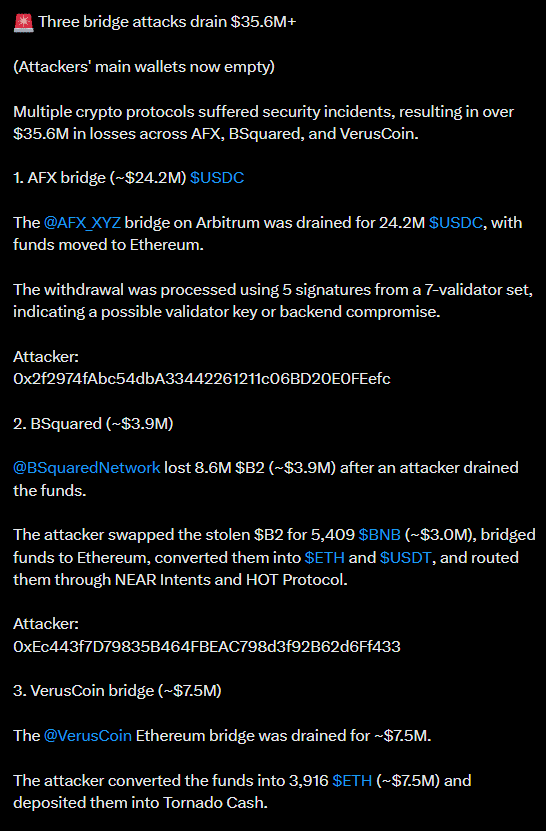
Notably, AFX suffered the biggest loss after attackers stole $24.2 million in USDC from its Arbitrum bridge and moved the funds to Ethereum.
BSquared Network was the second-largest victim, losing around $3.9 million after an attacker drained 8.6 million B2 tokens. VerusCoin also suffered a bridge exploit worth roughly $7.5 million, pushing the combined losses across the three protocols to $35.55 million.
Interestingly, all three attacks targeted the same part of the DeFi stack: Cross-chain bridges.
Put simply, even though the protocols operate in different ecosystems, the attack vector was identical.
That once again puts the spotlight on bridge infrastructure, which continues to be one of DeFi’s biggest security risks. The timing is also what makes this more interesting.
These exploits come as another key development is unfolding, adding fresh uncertainty to the market.
Crypto hacks put DeFi under pressure as the Drift exploit resurfaces
The $35 million exploit wave couldn’t have come at a worse time for DeFi.
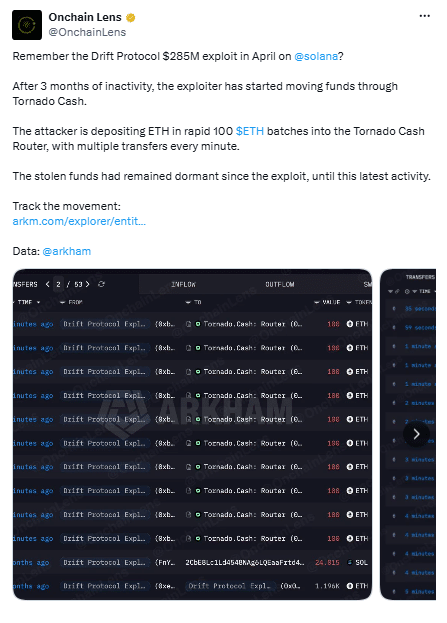
Just as three cross-chain bridges were hacked in a single day, the hacker behind the Drift exploit has started moving stolen funds again.
Earlier this year, Drift Protocol suffered one of the largest DeFi exploits after attackers drained $285 million, triggering a sharp wave of risk-off sentiment across the sector.
Now, the stolen funds are on the move again.
According to Onchain Lens, the attacker is funneling $ETH through the Tornado Cash Router in repeated 100 $ETH batches, with multiple transactions being executed every minute.
While the transfers don’t necessarily signal an immediate selloff, they have brought the Drift hack back into focus at a time when DeFi is already dealing with a fresh wave of bridge exploits.
Notably, this is where the timing starts to stand out.
According to DeFiLlama data, DeFi had finally started to regain momentum, with TVL climbing by more than $10 billion in July, marking the strongest monthly increase since the Q1-Q2 hack wave.
However, the latest $35 million in crypto hacks has injected fresh uncertainty into that recovery. If more exploits follow, the market could once again shift its focus from capital inflows to protocol security, reviving the same DeFi FUD that dominated earlier this year.
Final Summary
- Three bridge hacks wiped out $35.55 million in one day, while the hacker behind the $285 million Drift exploit started moving stolen funds again.
- After DeFi TVL recovered by over $10 billion in July, fresh crypto hacks could bring DeFi FUD back into the market.
