
 Bitcoin
  Ethereum
  Tether
  BNB
BNB  USDC
USDC  XRP
XRP  Solana
  TRON
TRON  Lido Staked Ether
  Figure Heloc
  Hyperliquid
  Dogecoin
  USDS
USDS  Rain
Rain  LEO Token
  Wrapped stETH
  Zcash
Zcash  WhiteBIT Coin
  Wrapped Bitcoin
  Cardano
  Binance Bridged USDT (BNB Smart Chain)
  Stellar
  Wrapped Beacon ETH
  Monero
  Chainlink
  Canton
  Wrapped eETH
  Bitcoin Cash
  Dai
Dai  sUSDS
sUSDS  USD1
USD1  Ethena USDe
  Gram (prev. Toncoin)
  Coinbase Wrapped BTC
  Litecoin
  Global Dollar
  Circle USYC
  WETH
WETH  Hedera
  Sui
Sui  PayPal USD
  USDT0
USDT0  Avalanche
  Cronos
  Tether Gold
  Shiba Inu
  NEAR Protocol
  BlackRock USD Institutional Digital Liquidity Fund
  Ondo US Dollar Yield
  Ethena Staked USDe
  Uniswap
  Bittensor
  World Liberty Financial
  PAX Gold
  MemeCore
  Aster
Aster  HTX DAO
  OKB
OKB  Ripple USD
  Ondo
Ondo  Little Pepe
  USDD
USDD  syrupUSDC
  Falcon USD
  Polkadot
  Morpho
  Mantle
  DeXe
DeXe  Aave
Aave  BFUSD
BFUSD  Worldcoin
  Sky
Sky  Internet Computer
  Bitget Token
  Pi Network
  Ethereum Classic
  Pepe
Pepe  United Stables
  Jupiter Perpetuals Liquidity Provider Token
  Spiko EU T-Bills Money Market Fund
  Blockchain Capital
  Quant
Quant  KuCoin
  Janus Henderson Anemoy Treasury Fund
  Jito Staked SOL
  USDGO
USDGO  Stable
  Kelp DAO Restaked ETH
  Invesco Short Duration US Government Securities Fund
  JUST
JUST  Binance-Peg WETH
  POL (ex-MATIC)
  Rocket Pool ETH
  Cosmos Hub
  Kaspa
Kaspa  Binance Bridged USDC (BNB Smart Chain)
  Render
  Algorand
  Wrapped BNB
  ADI
ADI  Function FBTC
  Beldex
  USDtb
USDtb  NEXO
NEXO  Jupiter
  LAB
LAB  syrupUSDT
  Spiko Amundi Overnight Swap Fund (EUR)
  币安人生 (BinanceLife)
  Gate
Gate  Binance Staked SOL
  Ethena
  Audiera
  Janus Henderson Anemoy AAA CLO Fund
  Filecoin
  GHO
GHO  Pump.fun
  NEW X CEO IS BACK
  Polygon Bridged USDC (Polygon PoS)
  Lighter
  Solv Protocol BTC
  Flare
Flare  Lombard Staked BTC
  Usual USD
  XDC Network
  YLDS
YLDS  clBTC
clBTC  Midnight
  Provenance Blockchain
  USX
USX  Aptos
Aptos  Aerodrome Finance
  Venice Token
  StakeWise Staked ETH
  TrueUSD
  Arbitrum
  Kinetiq Staked HYPE
  A7A5
A7A5  tBTC
tBTC  Injective
  PancakeSwap
  Dash
Dash  EURC
EURC  VeChain
  Ondo Short-Term U.S. Government Bond Fund
  Pudgy Penguins
  c8ntinuum
  Hastra PRIME
  Mantle Staked Ether
  Official Trump
  Celestia
  Polygon PoS Bridged DAI (Polygon POS)
  Ether.fi
  Resolv wstUSR
  Artificial Superintelligence Alliance
  COCA
COCA  Sun Token
  Bonk
Bonk  SPX6900
  Doge Strategy
  Liquid Staked ETH
  First Digital USD
  Arbitrum Bridged WBTC (Arbitrum One)
  LayerZero
  Virtuals Protocol
  Pyth Network
  The9bit
  Terra Luna Classic
  Wrapped Flare
  Kinesis Gold
  Sei
Sei  L2 Standard Bridged WETH (Base)
  apxUSD
  Steakhouse USDC Morpho Vault
  Curve DAO
  Stacks
  Jito
Jito  Monad
Monad  Kite
Kite  Binance-Peg XRP
  Gnosis
  Ether.Fi Liquid ETH
  Tezos
Tezos  Renzo Restaked ETH
  Lido DAO
  MegaUSD
  Noon
Noon  Royal Dollar
  sBTC
sBTC  AINFT
AINFT  BitTorrent
  Bitcoin SV
  Jupiter Staked SOL
  Pendle
  Savings USDD
  Olympus
  DoubleZero
  Plasma
  Marinade Staked SOL
  Legacy Frax Dollar

Most traders insist that this is the worst Bitcoin halving cycle in history, but data indicates the comparison may come from a skewed starting point.
These concerns have emerged due to Bitcoin’s ($BTC) performance since its fourth halving on April 19, 2024. The crypto asset now trades at $59,400, below the roughly $64,000 price it held on the day of the halving.
Bitcoin Halving-Day Buyers Still Underwater
This indicates that more than 800 days later, investors who bought Bitcoin on halving day are still sitting at a loss. This is the first time in Bitcoin’s history that halving-day buyers have remained underwater this far into a cycle. In every previous cycle, they were already in profit by this stage.
Bitcoin’s drop from its peak has also added to the concerns. Specifically, the crypto firstborn has fallen about 53% from its all-time high of around $126,000, reached on Oct. 6, 2025.
Now, while this decline is still smaller than the drops of more than 77% that followed the market peaks in 2018 and 2022, Bitcoin has not delivered the strong gains the market recorded in earlier cycles.
Skewed Starting Point
However, the halving date is a skewed starting point because this cycle began under conditions Bitcoin had never experienced before. Notably, $BTC had already reached a new all-time high of $73,800 on March 12, 2024, more than a month before the fourth halving.
This was a major change from previous cycles. In earlier halvings, Bitcoin had not yet moved above the previous bull market’s peak by the time the halving took place. As a result, on the halving day, the market still had room to climb before reaching new highs. This cycle followed a completely different path.
A major reason for the difference was the launch of U.S. spot Bitcoin ETFs in January 2024. These funds attracted massive institutional demand well before the halving reduced Bitcoin’s new supply. On the halving day, they had already attracted $12.3 billion in cumulative net inflows.
This early buying pushed Bitcoin’s price much higher before the halving even arrived, creating an unusually high starting point.
Realized Price Presents a Better Way to Compare Cycles
Many analysts consider realized price a better benchmark because it does not react as quickly to single events. Specifically, realized price measures the average cost of all coins in circulation based on the price at which each coin last moved on-chain.
Since realized price changes gradually as investors buy and sell Bitcoin, it is less affected by major events such as ETF approvals. This makes it a more stable way to compare different market cycles without the distortion created by Bitcoin’s unusually strong rally before the halving.
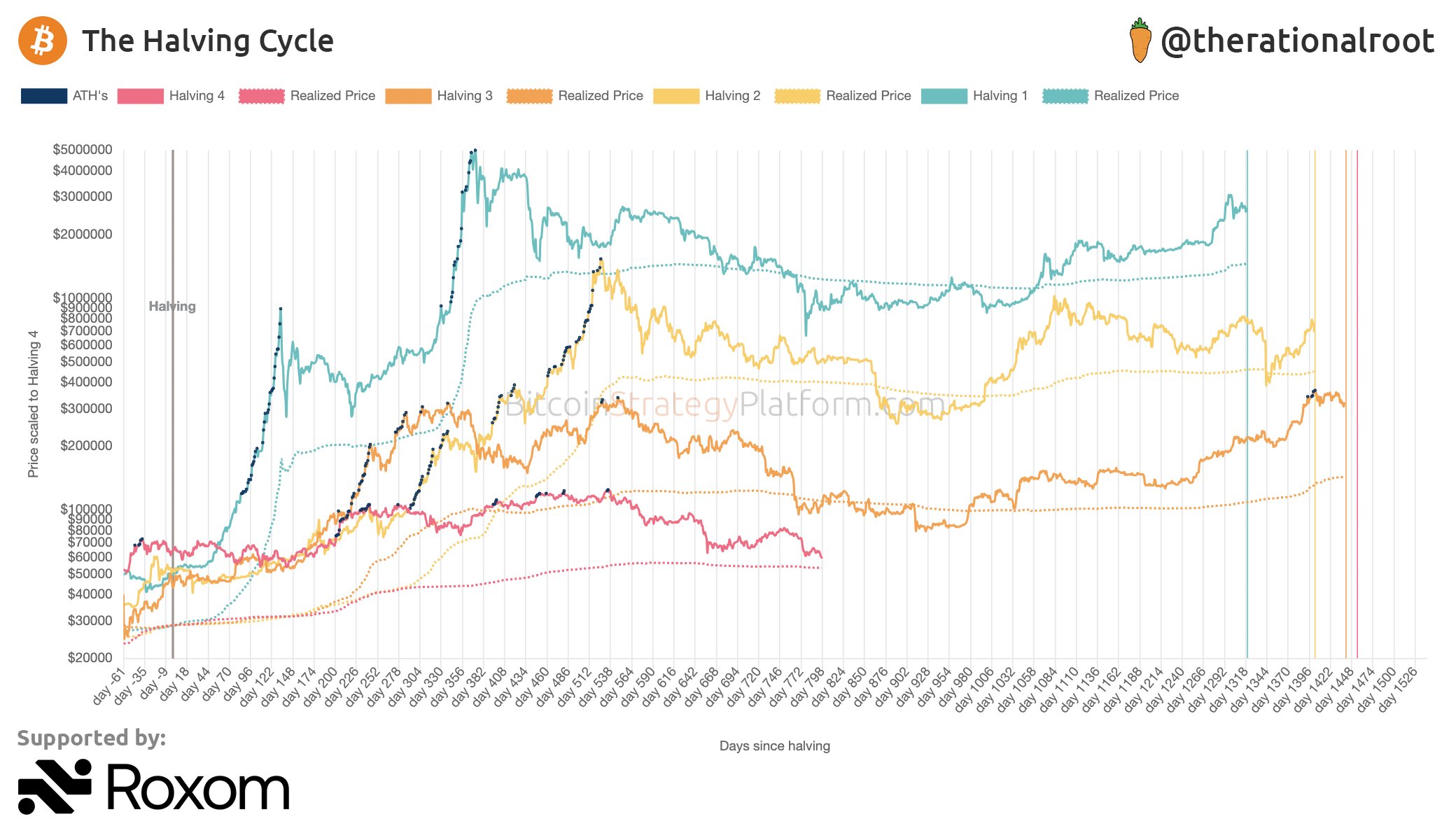
Bitcoin’s realized price currently stands at $53,197, while the spot price is around $59,400. That means the spot price trades at a premium of roughly 10% above the realized price, one of the smallest gaps seen during this cycle.
In past cycles, Bitcoin reached major market bottoms when the spot price moved this close to the realized price, including the lows recorded in 2015, late 2018 into 2019, and 2022.
Bitcoin Realized Price Still Shows This Has Been a Weak Cycle
Nonetheless, even after removing the effect of Bitcoin’s early rally, realized price does not make a bullish case for this cycle. Instead, it still points to weaker performance than previous halving periods.
During this cycle, the Bitcoin market price never moved far above realized price the way it did during the major bull market peaks of 2013, 2017, and 2021.
In those earlier cycles, heavy speculation pushed Bitcoin’s market value several times above the combined cost basis of all coins. Such a gap never developed this time, even when Bitcoin reached its record high in October 2025.
The smaller gap between spot price and realized price suggests this market has behaved differently from earlier ones. The current cycle has been shaped by steady institutional buying through spot Bitcoin ETFs instead of being driven mainly by retail speculation.
It is still too early to know whether this will lead to a smaller market bottom or simply a quieter bull market. However, while using realized price instead of the halving-day price removes the distortion caused by ETFs, it still indicates that the cycle has been worse than others at similar periods.
