
 Bitcoin
  Ethereum
  Tether
  BNB
BNB  USDC
USDC  XRP
XRP  Solana
  TRON
TRON  Lido Staked Ether
  Figure Heloc
  Hyperliquid
  Dogecoin
  USDS
USDS  Rain
Rain  LEO Token
  Wrapped stETH
  Zcash
Zcash  WhiteBIT Coin
  Wrapped Bitcoin
  Cardano
  Binance Bridged USDT (BNB Smart Chain)
  Stellar
  Wrapped Beacon ETH
  Monero
  Chainlink
  Canton
  Wrapped eETH
  Bitcoin Cash
  Dai
Dai  sUSDS
sUSDS  USD1
USD1  Ethena USDe
  Gram (prev. Toncoin)
  Coinbase Wrapped BTC
  Litecoin
  Global Dollar
  Circle USYC
  WETH
WETH  Hedera
  Sui
Sui  PayPal USD
  USDT0
USDT0  Avalanche
  Cronos
  Tether Gold
  Shiba Inu
  NEAR Protocol
  BlackRock USD Institutional Digital Liquidity Fund
  Ondo US Dollar Yield
  Ethena Staked USDe
  Uniswap
  Bittensor
  World Liberty Financial
  PAX Gold
  MemeCore
  Aster
Aster  HTX DAO
  OKB
OKB  Ripple USD
  Ondo
Ondo  Little Pepe
  USDD
USDD  syrupUSDC
  Falcon USD
  Polkadot
  Morpho
  Mantle
  DeXe
DeXe  Aave
Aave  BFUSD
BFUSD  Worldcoin
  Sky
Sky  Internet Computer
  Bitget Token
  Pi Network
  Ethereum Classic
  Pepe
Pepe  United Stables
  Jupiter Perpetuals Liquidity Provider Token
  Spiko EU T-Bills Money Market Fund
  Blockchain Capital
  Quant
Quant  KuCoin
  Janus Henderson Anemoy Treasury Fund
  Jito Staked SOL
  USDGO
USDGO  Stable
  Kelp DAO Restaked ETH
  Invesco Short Duration US Government Securities Fund
  JUST
JUST  Binance-Peg WETH
  POL (ex-MATIC)
  Rocket Pool ETH
  Cosmos Hub
  Kaspa
Kaspa  Binance Bridged USDC (BNB Smart Chain)
  Render
  Algorand
  Wrapped BNB
  ADI
ADI  Function FBTC
  Beldex
  USDtb
USDtb  NEXO
NEXO  Jupiter
  LAB
LAB  syrupUSDT
  Spiko Amundi Overnight Swap Fund (EUR)
  币安人生 (BinanceLife)
  Gate
Gate  Binance Staked SOL
  Ethena
  Audiera
  Janus Henderson Anemoy AAA CLO Fund
  Filecoin
  GHO
GHO  Pump.fun
  NEW X CEO IS BACK
  Polygon Bridged USDC (Polygon PoS)
  Lighter
  Solv Protocol BTC
  Flare
Flare  Lombard Staked BTC
  Usual USD
  XDC Network
  YLDS
YLDS  clBTC
clBTC  Midnight
  Provenance Blockchain
  USX
USX  Aptos
Aptos  Aerodrome Finance
  Venice Token
  StakeWise Staked ETH
  TrueUSD
  Arbitrum
  Kinetiq Staked HYPE
  A7A5
A7A5  tBTC
tBTC  Injective
  PancakeSwap
  Dash
Dash  EURC
EURC  VeChain
  Ondo Short-Term U.S. Government Bond Fund
  Pudgy Penguins
  c8ntinuum
  Hastra PRIME
  Mantle Staked Ether
  Official Trump
  Celestia
  Polygon PoS Bridged DAI (Polygon POS)
  Ether.fi
  Resolv wstUSR
  Artificial Superintelligence Alliance
  COCA
COCA  Sun Token
  Bonk
Bonk  SPX6900
  Doge Strategy
  Liquid Staked ETH
  First Digital USD
  Arbitrum Bridged WBTC (Arbitrum One)
  LayerZero
  Virtuals Protocol
  Pyth Network
  The9bit
  Terra Luna Classic
  Wrapped Flare
  Kinesis Gold
  Sei
Sei  L2 Standard Bridged WETH (Base)
  apxUSD
  Steakhouse USDC Morpho Vault
  Curve DAO
  Stacks
  Jito
Jito  Monad
Monad  Kite
Kite  Binance-Peg XRP
  Gnosis
  Ether.Fi Liquid ETH
  Tezos
Tezos  Renzo Restaked ETH
  Lido DAO
  MegaUSD
  Noon
Noon  Royal Dollar
  sBTC
sBTC  AINFT
AINFT  BitTorrent
  Bitcoin SV
  Jupiter Staked SOL
  Pendle
  Savings USDD
  Olympus
  DoubleZero
  Plasma
  Marinade Staked SOL
  Legacy Frax Dollar

Coinbase became the latest crypto company to cut its workforce on Tuesday, as a wave of layoffs sweeps through an industry navigating a down market and the pressure to embrace AI.
CEO Brian Armstrong said the company is using AI to flatten its organizational structure, with managers expected to act more like “player-coaches.”
“AI is bringing a profound shift in how companies operate, and we’re reshaping Coinbase to lead in this new era. This is a new way of working, and we need to leverage AI across every facet of our jobs,” Armstrong said in an email to employees, also shared on X on Tuesday.
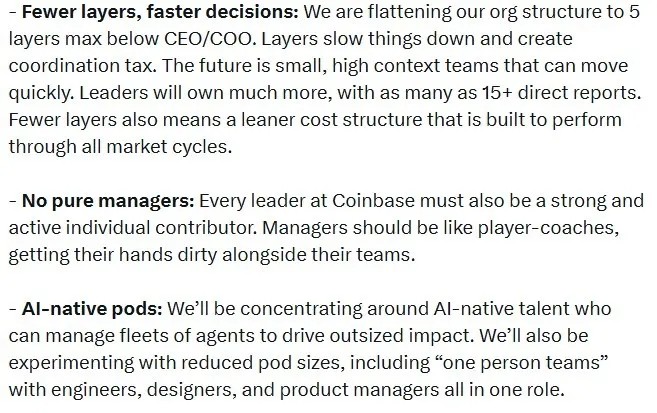
Armstrong’s memo outlined three sweeping changes to how Coinbase will operate. Source: Brian Armstrong
Block and Crypto.com have made similar moves in recent months, citing AI-driven efficiency gains that allow leaner teams to handle what once required larger headcounts.
Coinbase and Crypto.com cut about 700 and 180 employees respectively. Jack Dorsey’s Block handed out 4,000 pink slips in February to reduce the company to under 6,000 employees.
Crypto has weathered several bear markets before, and layoffs have always followed. But this time, the companies doing the cutting are using the downturn to rebuild with AI at the center.
Coinbase misses Q1 expectation
Coinbase’s Tuesday filing with the Securities and Exchange Commission detailed that the exchange expects its restructuring plan to cost up to $60 million in expenses tied to severance and termination benefits.
Clear Street analyst Owen Lau told CNBC that Coinbase wants to “tell investors that management is actively managing the cost base to deliver positive adjusted EBITDA through the cycle.”
“The first quarter results are expected to be weak because of the crypto bear market,” added Lau.
On Thursday, Coinbase reported a weaker-than-expected first-quarter loss as falling crypto prices dragged down spot trading revenue. The exchange posted a net loss of $1.49 per share on $1.41 billion in revenue, missing analyst expectations while transaction revenue fell short amid weaker trading activity.
The underperformance isn’t specific to Coinbase, as Bitcoin lost 21% of its value in Q1. Across the tech industry, headcounts that ballooned during the bull run are now coming back down, with executives increasingly pointing to AI as the catalyst.
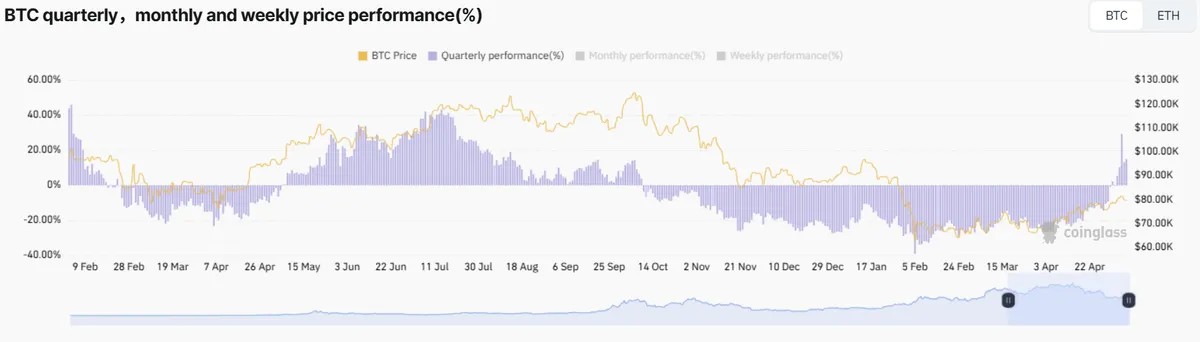
Bitcoin has been in the red for two consecutive quarters but showed signs of recovery in April. Source: Coinglass
Related: Reality of AI’s impact on employment clashes with C-suite optimism
Whether AI is the real driver or a convenient explanation depends on who you ask. Speaking at the recent Semafor World Economy conference, Scale AI CEO Jason Droege pushed back on the idea of AI presenting a “white-collar apocalypse,” arguing that many companies are using the technology as cover.
“A lot of the layoffs that are happening right now because of AI, if you really dig in, it’s sort of like washing the layoffs,” Droege said. “A lot of these companies are saying it’s because of AI, but a lot of it is just like rightsizing and they need an excuse.”
AI leads job cut reasoning for second consecutive month
According to jobs tracker Layoffs.fyi, the global tech industry in 2026 Q1 had the most layoffs since 2023 Q1, with more than 81,747 people losing their jobs. March was hit the hardest, with 45,800 layoffs in the month.
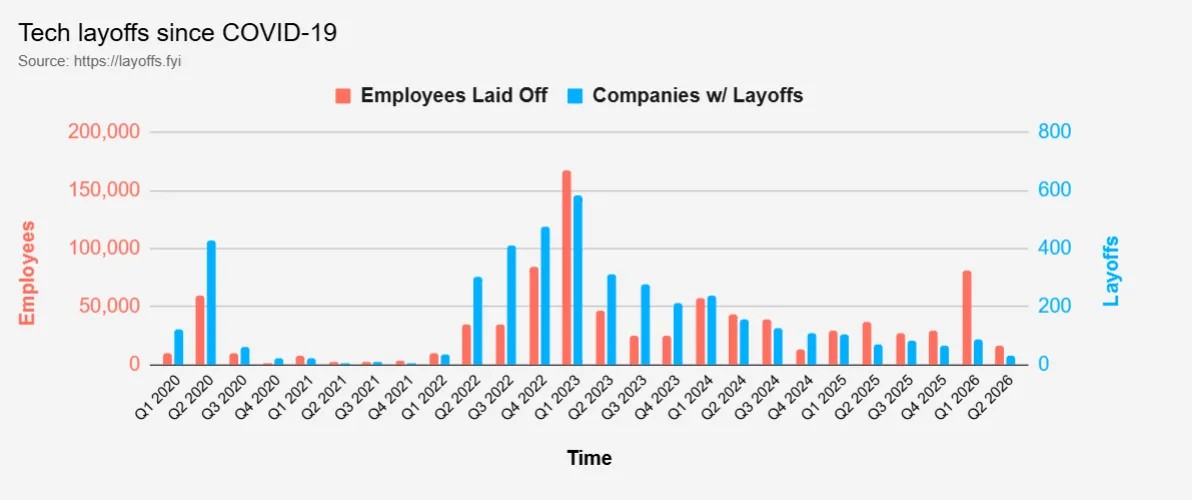
Tech layoffs surged in early 2026, marking the industry’s highest quarterly job cuts since 2023. Source: Layoffs.fyi
Related: How AI agents can reshape arbitrage in prediction markets
The slowdown has continued into the first month of this quarter. According to a Thursday report from outplacement firm Challenger, Gray & Christmas, US employers announced 83,387 job cuts in April, up 30% from the 60,620 cuts recorded in March.
AI led all reasons for job cuts in April for the second consecutive month, though it is not the leading cause for the year so far. Market conditions led with 53,058 cuts, followed by closings at 52,187.
“Technology companies continue to announce large-scale cuts and are leading all industries in layoff announcements. They are also often citing AI spend and innovation. Regardless of whether individual jobs are being replaced by AI, the money for those roles is,” said Andy Challenger, chief revenue officer at Challenger, Gray & Christmas.
Crypto has always been cyclical, but the framing around this wave of cuts looks different from the last major downturn. During the 2022–2023 crypto crash, companies were largely reacting to collapsing token prices, the fallout from FTX and balance sheets strained by aggressive bull-market hiring.
This time, executives are increasingly presenting layoffs as proactive restructuring tied to AI adoption and operational efficiency.
Both Dorsey and Armstrong signalled that their companies remain well-capitalized, framing the cuts as deliberate attempts to flatten corporate structures rather than emergency survival measures.
Same playbook, new reason
Crypto recoveries have come fast, and when they do, businesses often enter hiring sprees to expand during the bull market. Coinbase has been here before. It cut 18% in 2022, then hired aggressively when prices rebounded.
This time, Armstrong is betting the AI-native model means he won’t have to.
Kraken was making the same argument in October 2024, when it slashed 15% of its workforce.
In a blog post, co-CEOs Arjun Sethi and Dave Ripley said the exchange had “fallen into the trap of building organizational layers” and needed to become “leaner and faster” by giving power back to individual contributors over managers.
The language is similar to Armstrong’s and Dorsey’s memos. The difference is, Kraken didn’t mention AI.
Leaner teams, flatter structures, faster decisions. Crypto has been here before, but AI is the latest reason why.
Magazine: Guide to the top and emerging global crypto hubs: Mid-2026
Cointelegraph is committed to independent, transparent journalism. This news article is produced in accordance with Cointelegraph’s Editorial Policy and aims to provide accurate and timely information. Readers are encouraged to verify information independently.
