
 Bitcoin
  Ethereum
  Tether
  BNB
BNB  USDC
USDC  XRP
XRP  Solana
  TRON
TRON  Lido Staked Ether
  Figure Heloc
  Hyperliquid
  Dogecoin
  USDS
USDS  Rain
Rain  LEO Token
  Wrapped stETH
  Zcash
Zcash  WhiteBIT Coin
  Wrapped Bitcoin
  Cardano
  Binance Bridged USDT (BNB Smart Chain)
  Stellar
  Wrapped Beacon ETH
  Monero
  Chainlink
  Canton
  Wrapped eETH
  Bitcoin Cash
  Dai
Dai  sUSDS
sUSDS  USD1
USD1  Ethena USDe
  Gram (prev. Toncoin)
  Coinbase Wrapped BTC
  Litecoin
  Global Dollar
  Circle USYC
  WETH
WETH  Hedera
  Sui
Sui  PayPal USD
  USDT0
USDT0  Avalanche
  Cronos
  Tether Gold
  Shiba Inu
  NEAR Protocol
  BlackRock USD Institutional Digital Liquidity Fund
  Ondo US Dollar Yield
  Ethena Staked USDe
  Uniswap
  Bittensor
  World Liberty Financial
  PAX Gold
  MemeCore
  Aster
Aster  HTX DAO
  OKB
OKB  Ripple USD
  Ondo
Ondo  Little Pepe
  USDD
USDD  syrupUSDC
  Falcon USD
  Polkadot
  Morpho
  Mantle
  DeXe
DeXe  Aave
Aave  BFUSD
BFUSD  Worldcoin
  Sky
Sky  Internet Computer
  Bitget Token
  Pi Network
  Ethereum Classic
  Pepe
Pepe  United Stables
  Jupiter Perpetuals Liquidity Provider Token
  Spiko EU T-Bills Money Market Fund
  Blockchain Capital
  Quant
Quant  KuCoin
  Janus Henderson Anemoy Treasury Fund
  Jito Staked SOL
  USDGO
USDGO  Stable
  Kelp DAO Restaked ETH
  Invesco Short Duration US Government Securities Fund
  JUST
JUST  Binance-Peg WETH
  POL (ex-MATIC)
  Rocket Pool ETH
  Cosmos Hub
  Kaspa
Kaspa  Binance Bridged USDC (BNB Smart Chain)
  Render
  Algorand
  Wrapped BNB
  ADI
ADI  Function FBTC
  Beldex
  USDtb
USDtb  NEXO
NEXO  Jupiter
  LAB
LAB  syrupUSDT
  Spiko Amundi Overnight Swap Fund (EUR)
  币安人生 (BinanceLife)
  Gate
Gate  Binance Staked SOL
  Ethena
  Audiera
  Janus Henderson Anemoy AAA CLO Fund
  Filecoin
  GHO
GHO  Pump.fun
  NEW X CEO IS BACK
  Polygon Bridged USDC (Polygon PoS)
  Lighter
  Solv Protocol BTC
  Flare
Flare  Lombard Staked BTC
  Usual USD
  XDC Network
  YLDS
YLDS  clBTC
clBTC  Midnight
  Provenance Blockchain
  USX
USX  Aptos
Aptos  Aerodrome Finance
  Venice Token
  StakeWise Staked ETH
  TrueUSD
  Arbitrum
  Kinetiq Staked HYPE
  A7A5
A7A5  tBTC
tBTC  Injective
  PancakeSwap
  Dash
Dash  EURC
EURC  VeChain
  Ondo Short-Term U.S. Government Bond Fund
  Pudgy Penguins
  c8ntinuum
  Hastra PRIME
  Mantle Staked Ether
  Official Trump
  Celestia
  Polygon PoS Bridged DAI (Polygon POS)
  Ether.fi
  Resolv wstUSR
  Artificial Superintelligence Alliance
  COCA
COCA  Sun Token
  Bonk
Bonk  SPX6900
  Doge Strategy
  Liquid Staked ETH
  First Digital USD
  Arbitrum Bridged WBTC (Arbitrum One)
  LayerZero
  Virtuals Protocol
  Pyth Network
  The9bit
  Terra Luna Classic
  Wrapped Flare
  Kinesis Gold
  Sei
Sei  L2 Standard Bridged WETH (Base)
  apxUSD
  Steakhouse USDC Morpho Vault
  Curve DAO
  Stacks
  Jito
Jito  Monad
Monad  Kite
Kite  Binance-Peg XRP
  Gnosis
  Ether.Fi Liquid ETH
  Tezos
Tezos  Renzo Restaked ETH
  Lido DAO
  MegaUSD
  Noon
Noon  Royal Dollar
  sBTC
sBTC  AINFT
AINFT  BitTorrent
  Bitcoin SV
  Jupiter Staked SOL
  Pendle
  Savings USDD
  Olympus
  DoubleZero
  Plasma
  Marinade Staked SOL
  Legacy Frax Dollar
Prediction Markets See a Blue Wave Brewing in Washington
After years of lobbying, millions spent on political campaigns and countless negotiations over cryptocurrency legislation, the industry could find itself back at square one. With November’s midterm elections approaching, prediction markets increasingly favor Democrats taking control of both chambers of Congress, potentially handing the party considerable influence over the next chapter of federal digital asset regulation.
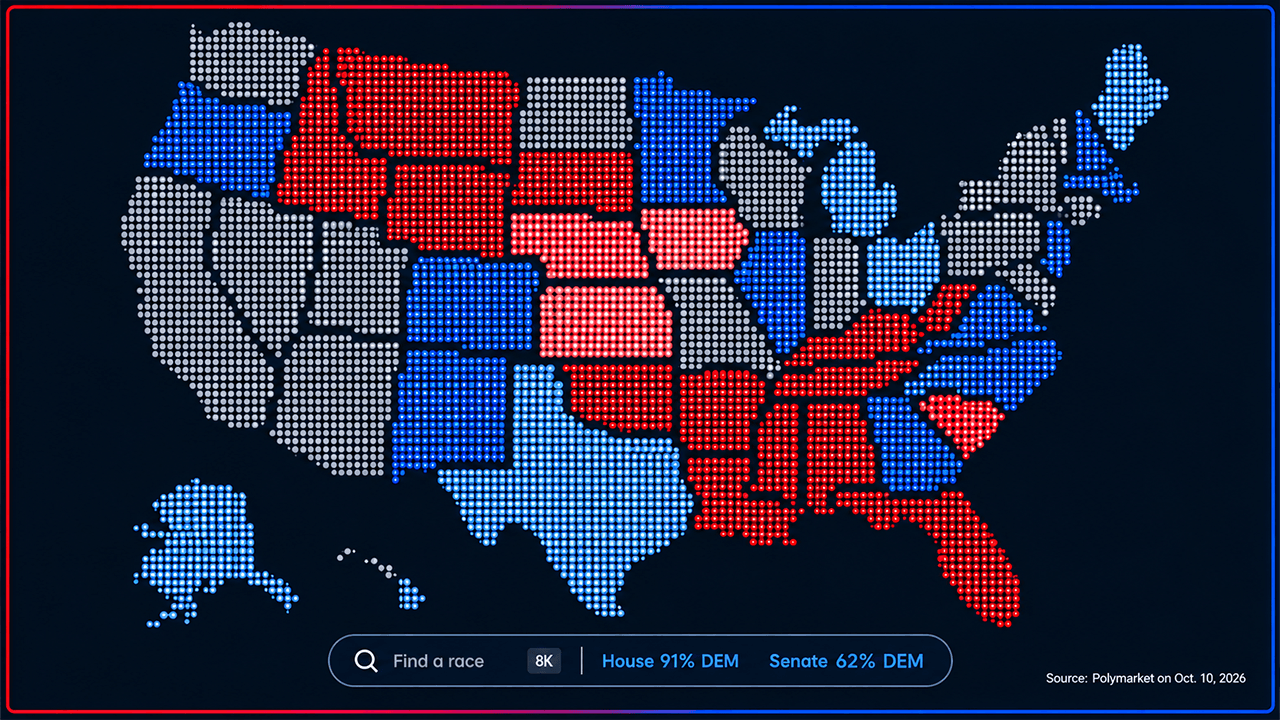
On Oct. 10, the prediction marketplace Polymarket’s Balance of Power market assigned a 62% probability to Democrats capturing both the House and Senate, with more than $21.2 million in trading volume at press time. A Republican Senate paired with a Democratic House carried 30% odds, while a Republican sweep stood at just 9%. The reverse arrangement, a Democratic Senate and Republican House, registered 1%, and other outcomes accounted for less than 1%.
Kalshi’s competing market paints almost the same picture. With approximately $35.87 million traded, its contracts give Democrats a 61% chance of sweeping Congress, compared with 29% for a Democratic House and Republican Senate. A Republican sweep commands 11%, while a Republican House and Democratic Senate stands at just 0.9%.
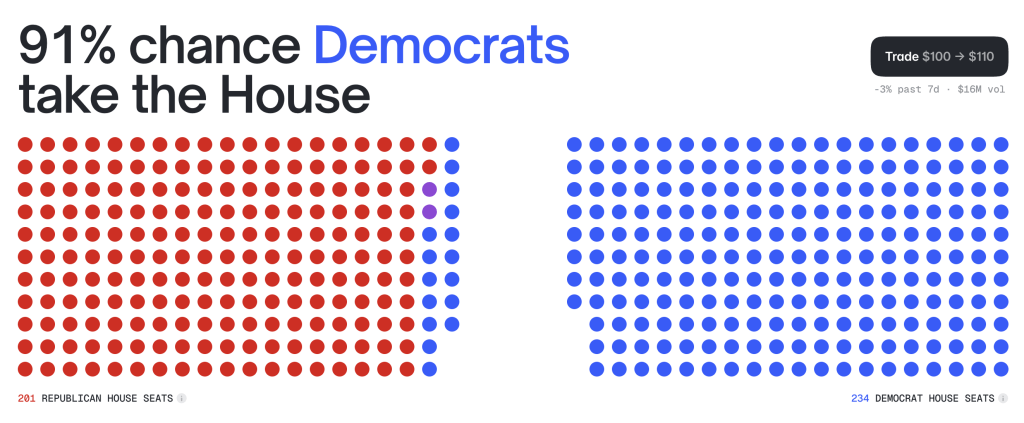
The individual chamber markets offer another revealing look at the political arithmetic. Polymarket gives Democrats a commanding 91% chance of controlling the House, with Republicans at 10%, and projects a 234-201 Democratic majority. Its separate “Blue Wave in 2026” contract carries 87% odds, suggesting traders anticipate considerable Democratic gains.
The Senate remains a tighter contest. Polymarket gives Democrats 63% odds against Republicans’ 38%, with approximately $6.23 million traded and a projected 52-48 Democratic majority. Kalshi’s Senate market, which has attracted $57.3 million in volume, puts Democrats at 61% and Republicans at 39%. These figures aren’t guarantees, but they reveal where traders currently believe the political winds are blowing.
Senate Battlegrounds Could Decide Crypto’s Regulatory Future
Several competitive Senate races help explain the Democratic advantage. Polymarket favors James Talarico in Texas at 64%, Troy Jackson in Maine at 59%, Abdul El-Sayed in Michigan at 72%, Mary Peltola in Alaska at 74%, and Sherrod Brown in Ohio at 62%. Republican participants retain advantages in Kansas, where Roger Marshall holds 62%, Iowa, where Ashley Hinson commands 57%, South Carolina, where Darline Graham Nordone stands at 85%, and Nebraska, where Pete Ricketts carries 72%.
Meanwhile, 36 states will elect governors on Nov. 3, with Republicans and Democrats each defending 18 seats. Polymarket favors Xavier Becerra in California at 96%, Greg Abbott in Texas at 77%, Byron Donalds in Florida at 78%, Jocelyn Benson in Michigan at 94%, David Crowley in Wisconsin at 81%, Amy Acton in Ohio at 70% and Aaron Ford in Nevada at 55%. Georgia remains a toss-up, with Rick Jackson at 52% against Keisha Lance Bottoms at 48%.
Other election-related markets are attracting attention, too. The state of California‘s proposed billionaire wealth tax carries 25% approval odds, Idaho’s abortion legalization measure stands at 51%, Michigan’s constitutional convention proposal faces an 89% probability of rejection, and Colorado’s life-sentence measure for underage sex traffickers holds 71% approval odds.
While those gubernatorial and ballot contests won’t determine congressional control, they illustrate the breadth of political wagering ahead of November. For cryptocurrency businesses, however, the congressional numbers carry the greatest consequences.
CLARITY Act Faces an Uphill Battle After September Defeat
The Digital Asset Market Clarity Act, commonly called the CLARITY Act, was supposed to settle Washington’s long-running argument over cryptocurrency oversight. Approved by the House in July 2025 through a bipartisan 294-134 vote, the legislation sought to establish clearer responsibilities for the Commodity Futures Trading Commission (CFTC) and Securities and Exchange Commission (SEC).
Under the proposal, qualifying digital commodities would fall primarily under CFTC supervision, while the SEC would retain authority over securities-related activities. Exchanges, brokers and dealers would face registration and disclosure requirements, with certain exemptions available for mature decentralized networks.
But negotiations eventually hit a wall. Despite Republicans incorporating 126 substantive changes requested by Democrats, the Senate rejected a procedural motion Sept. 15, 2026, by a 49-50 vote, falling 11 votes short of the required 60. Every Democrat present opposed advancing the measure, joined by four Republicans.
Disagreements centered on ethics restrictions involving federal officials’ cryptocurrency holdings, illicit-finance safeguards, developer liability and stablecoin rewards competing with bank deposits. President Donald Trump‘s reported cryptocurrency-related income exceeding $1.4 billion became another sticking point, with Democrats demanding stronger conflict-of-interest protections.
With the current congressional session winding down, the legislation’s prospects have effectively collapsed. Any successor would require fresh consideration when the 120th Congress convenes in January 2027, potentially under Democratic leadership.
Ten Reasons a Democratic Sweep Could Put Crypto in a Bind
A Democratic takeover wouldn’t outlaw cryptocurrency or automatically reverse existing regulations. Nevertheless, it could make the industry’s preferred legislative framework considerably harder to achieve, with ten potential consequences standing out.
First, committee leadership would change hands. Democrats would control the congressional panels responsible for financial services, banking, and agricultural oversight, giving them authority over hearings, legislative calendars, and negotiations.
Second, the CLARITY Act’s existing framework would face a reset. New legislation would require reintroduction, and Democratic leaders could demand revisions far beyond the 126 changes previously negotiated.
Third, ethics restrictions could become nonnegotiable. Democratic lawmakers have pushed for stronger safeguards governing cryptocurrency profits involving presidents, senior federal officials, and their families, including potential divestment and blind-trust requirements.
Fourth, decentralized finance (DeFi) could face tougher compliance obligations. Expanded anti-money-laundering provisions involving mixers, noncustodial applications, and software developers could increase legal exposure and operating costs.
Fifth, stablecoin rewards could face tighter restrictions. Banking organizations and some Democratic lawmakers have raised concerns that yield-bearing stablecoins could divert deposits away from traditional financial institutions.
Sixth, existing agency initiatives could encounter resistance. Democratic majorities could challenge SEC and CFTC cryptocurrency policies through congressional oversight, funding restrictions, and legislative measures, although reversing those rules wouldn’t be automatic.
Seventh, investigations could intensify. Congressional committees could examine Trump-family cryptocurrency ventures, exchange custody practices, stablecoin reserves, and political spending across the digital asset industry.
Eighth, cryptocurrency political spending could lose some influence. Industry-backed organizations such as Fairshake have committed tens of millions to congressional races, including a reported $30 million effort opposing Ohio Democrat Sherrod Brown.
Ninth, bipartisan negotiations could become more complicated. Democrats might prioritize stronger SEC authority, consumer protections, and financial crime provisions, potentially departing from the industry’s preferred CFTC-centered approach.
Tenth, legislative progress could stretch into 2027 or beyond. New committee leadership, competing priorities, and renewed negotiations could delay comprehensive legislation, leaving businesses dependent on existing statutes and agency interpretations.
Collectively, these possibilities suggest a Democratic sweep could substantially change Washington’s approach to cryptocurrency regulation. Still, Democrats aren’t uniformly opposed to digital assets, and bipartisan support for market-structure legislation has existed before. The central dispute concerns what protections and restrictions should accompany that legislation.
November’s Election Could Rewrite Washington’s Crypto Playbook
Even if Democrats capture Congress, Trump would remain president, and legislation would still require his signature or sufficient support to override a veto. Existing regulatory agencies would also retain their statutory responsibilities, meaning congressional control alone wouldn’t instantly dismantle the administration’s cryptocurrency policies.
Prediction markets have another limitation worth remembering. Their probabilities reflect contract prices, not certain election outcomes, and political developments could change the numbers considerably before Nov. 3. Polymarket and Kalshi also use specific settlement rules governing chamber control, independents, potential ties and delayed election results.
Nevertheless, the industry’s predicament is becoming difficult to ignore. Alongside this, even prediction markets themselves may feel some changes ahead if Democratic leaders take the majority. After years of negotiations, substantial political spending, and a failed Senate compromise, cryptocurrency companies could enter 2027 facing an entirely different legislative agenda.
The irony is that the CLARITY Act was supposed to end Washington’s regulatory guessing game. Instead, with Democrats favored to capture Congress, the cryptocurrency industry may soon discover that getting legislation through Washington is one thing, but keeping the political support needed to finish the job is another.
